
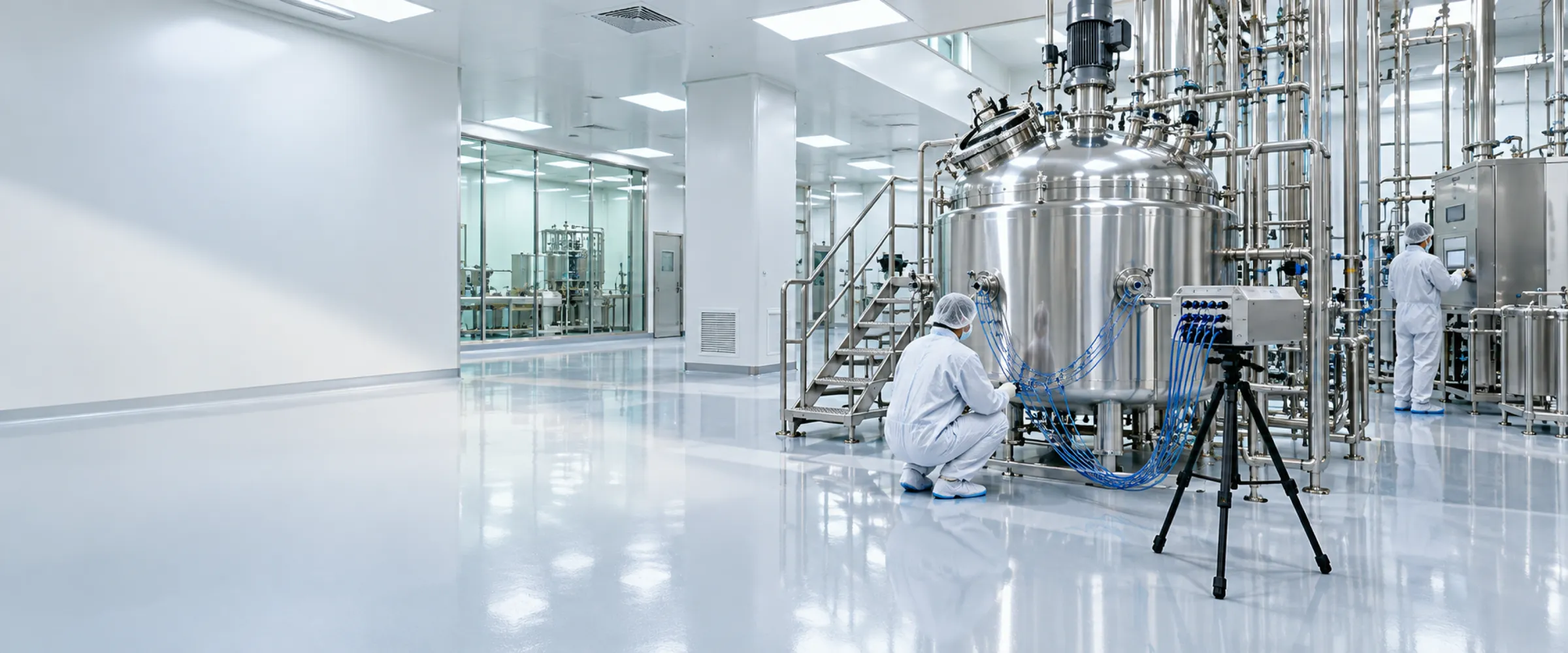
Cleanroom · Pressure
Differential & Static Pressure
Pressure differences manage room airflow and reveal filter resistance. Distinguish their purpose, measurement and limits.
DefinitionsFour pressure terms
| Term | Meaning | Measurement or application |
|---|---|---|
| Static pressure Ps | Pressure excluding the flow's kinetic component; may be positive or negative relative to the reference atmosphere | Duct wall static tap; room static pressure |
| Velocity pressure Pv | Kinetic component associated with air velocity; Pv = ρv²/2 for low-speed flow | Velocity from the difference between Pitot total and static pressures |
| Total pressure Pt | Sum of static and velocity pressures at the same point: Pt = Ps + Pv | Duct system energy and loss assessment |
| Differential pressure ΔP | Difference between two measurement points: P1 − P2 | Room-to-room pressure and filter pressure drop; not a synonym for static pressure |
Pressure CascadeRoom pressure cascades
A typical product-protection cascade holds cleaner rooms at higher pressure so air flows towards the lower grade. Supply, return and exhaust balance together with leakage through doors and gaps determine pressure; a set point alone cannot guarantee airflow direction.
EU GMP Annex 1 (2022), 4.14 gives a minimum 10 Pa between adjacent rooms of different grades as a guidance value. It is not a universal set point for all cleanrooms. Containment of pathogenic or highly toxic materials may require negative pressure and dedicated airlocks.
Check airflow with door operation and personnel movement included. Record and alarm critical pressure differences, distinguishing normal closed-door limits from justified alarm delays and recovery after door opening.
MeasurementMethods and instruments
| Object | Instrument and connection | Conditions to record |
|---|---|---|
| Room differential | Connect the high/low ports of a low-range differential gauge or transmitter to the rooms | Measured/reference room, door state, operating mode, units and sign |
| Duct static pressure and velocity | Static tap, or Pitot tube and differential manometer; check alignment and straight-run conditions | Positions and traverse points, velocity distribution and air-density correction |
| Filter pressure drop | Connect static taps upstream and downstream of the filter | Filter type, reference flow, initial/current drop and alarm limit |
Check zero, tube leaks, kinks and reversed ports. Use calibrated instruments with suitable range and resolution; compare trends at equivalent airflow and door conditions.
Filter ConditionHEPA pressure drop and replacement timing
HEPA filters do not have a universal replacement interval in years. Record initial pressure drop at reference flow and plan replacement using the manufacturer's terminal pressure drop, maintained design airflow, integrity-test results and contamination or damage risks.
Rising pressure drop can indicate dust loading or prefilter problems. A sudden drop may also mean reduced airflow, a sensing-tube fault or filter damage; low pressure drop alone does not prove filter integrity.
After replacement, check seating, seals and installed-filter leakage, then rebalance airflow and room pressure. For GMP facilities, define requalification from the change impact and record results and the new baseline pressure drop.
FAQFrequently asked questions
Frequently asked questions
Are static pressure and differential pressure the same?
Static pressure is a pressure component; differential pressure is a difference between two readings. Comparing room static pressures gives a room differential, while filter drop is a different measurement serving a different purpose.
Must every cleanroom have a 10 Pa differential?
10 Pa is the minimum guidance value in EU GMP Annex 1 for adjacent rooms of different grades. Set and approve actual limits from cleanliness, containment, leakage, door operation and airflow assessments.
How many years should a HEPA filter last?
There is no universal service life. Use pressure trends at comparable airflow, manufacturer limits, delivered airflow, integrity, contamination and damage. A scheduled test interval is not a mandatory replacement interval.
ReferencesSources
Contact Us
Your next project starts here.
Talk to us about the right engineering approach for your facility, scale and schedule.