
GMP · Purified Water
Pharmaceutical Water Systems
Pharmaceutical water is both an ingredient and a cleaning and rinsing medium, and each use calls for a defined grade. Every grade has a pharmacopoeial specification, and keeping that quality all the way to the point of use depends as much on how the storage and distribution system is designed and built as on the generation unit.
Water GradesGrades of pharmaceutical water
DI water and RO water, as the terms are used on site, name the process that made the water; the grades with pharmacopoeial specifications are purified water, water for injections and pure steam (tested as condensate). Whatever the process, the finished water has to meet the specification for its grade.
- DI water (deionised)
Water stripped of ions by ion-exchange resin. It names a process or intermediate, not a pharmacopoeial grade.
Resin regeneration and microbial growth in the resin bed have to be managed.
- RO water (reverse osmosis)
Water that has passed a reverse-osmosis membrane: the main desalination step in making purified water, not a grade in its own right.
Membrane fouling or damage is watched continuously, for example by conductivity.
- Purified water (PW)
Water for pharmaceutical use made from drinking-quality feed by distillation, ion exchange, reverse osmosis or another suitable process. Used to make non-sterile products and for cleaning, among other uses.
- Water for injections (WFI)
The grade used to make parenterals and other sterile products, with endotoxin control added. Traditionally made by distillation; USP accepts a process equivalent or superior to distillation, and since April 2017 the European Pharmacopoeia accepts reverse osmosis combined with appropriate techniques.
- Pure steam
Steam that contacts product surfaces, for example to sterilise process equipment and containers. It comes from a dedicated pure-steam generator; the condensate quality criteria are set by the applicable pharmacopoeia and the user's specification.
| Test | Purified water | Water for injection | Notes |
|---|---|---|---|
| Conductivity | ≤ 2.1 µS/cm (25 °C) | ≤ 2.1 µS/cm (25 °C) | Measured at 25 ± 1 °C with stirring, once the change over 5 minutes is 0.1 µS/cm or less |
| Total organic carbon | ≤ 0.50 mg/L | ≤ 0.50 mg/L | - |
| Bacterial endotoxins | - | < 0.25 EU/mL | - |
| Microbial count | - | - | USP <1231> action levels (guidance): purified water 100 CFU/mL, water for injection 10 CFU/100 mL |
Korean Pharmacopoeia, MFDS Notice 2026-44 (effective 30 September 2026), Part II monographs Purified Water in Bulk and Water for Injection. Purified water in containers is a separate monograph with a total aerobic microbial count of 100 CFU/mL or less.
The absence of a microbial figure in the bulk monographs does not remove microbial control: alert and action levels are set for each system. Products for export are checked against the current edition of the relevant pharmacopoeia.
| Use | Minimum grade |
|---|---|
| Parenteral formulation | Water for injection |
| Formulation before sterile freeze-drying | Water for injection |
| Non-sterile oral formulation | Purified water |
| Granulation, tablet coating | Purified water |
| Final rinse of equipment and containers | Sterile parenterals: water for injection Non-sterile and sterile non-parenterals: purified water (or the manufacturing grade if higher) |
Examples selected from Tables 1-5 of the EMA Guideline on the quality of water for pharmaceutical use (2020, effective 1 February 2021); the actual grade is set per product and by risk assessment.
GenerationPurified water generation
A typical train protects the RO membranes with pretreatment, removes ions with RO and EDI, then collects the water in a storage tank and circulates it through a loop. The equipment and its capacity are set from the feed-water analysis and the user requirements (URS).
- 01Feed water
The feed for purified water has to meet drinking-water quality.
- 02Pretreatment
Reduces turbidity, hardness and residual chlorine to protect the RO membranes (media filtration, softener, activated carbon or chemical dechlorination).
- 03Cartridge filter
Catches fine particles ahead of the RO stage to limit membrane fouling.
- 04RO
The main desalination step: the membrane rejects most ions, organics and microorganisms.
- 05EDI
Removes the remaining ions continuously with an electric field, lowering conductivity without regenerant chemicals.
- 06PW storage tank
Buffers changes in demand; a hydrophobic vent filter keeps outside air contamination out as the tank breathes.
- 07Distribution pump
Keeps the loop circulating so water never stands still.
- 08Heat exchanger
Holds the circulation temperature and is used for hot-water sanitisation.
- 09UV unit
An aid against microbial growth in the circulating water; it does not replace periodic sanitisation.
- 10Instruments
Monitors conductivity, TOC, temperature and flow online and continuously.
- 11Points of use
Where water is drawn through sanitary valves; microbial samples are taken here too.
Water for injections is made by distilling purified water or similar feed (multiple-effect or vapour-compression stills) or by an equivalent process the pharmacopoeia accepts, and is stored and distributed under conditions that inhibit microbial growth, such as hot circulation. Pure steam comes from a dedicated generator and is piped to its users with condensate removal and line slopes in mind.
Loop DesignStorage and distribution loop design
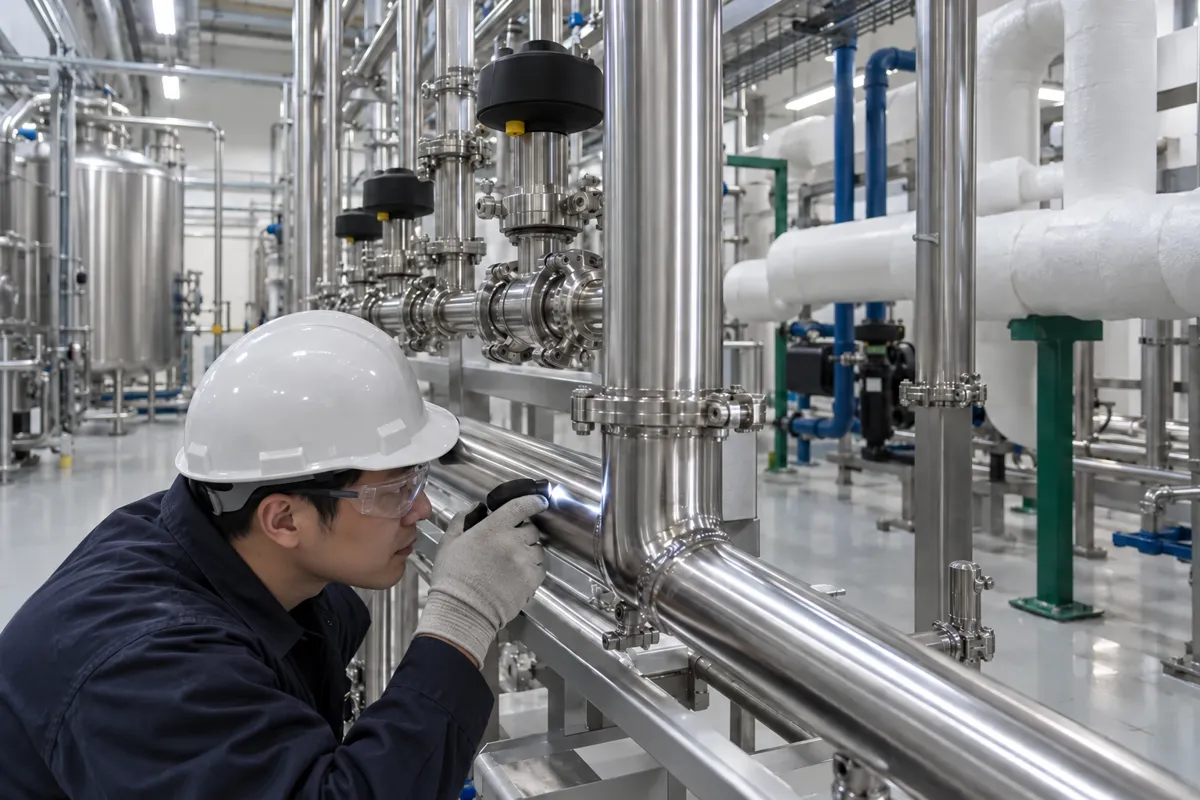
Even when the generation unit meets the specification, standing water or biofilm will spoil the quality at the points of use. The loop is therefore designed and built to leave microorganisms no place to grow.
- Continuous circulation
Distribution normally circulates continuously, with the pump and pipe sizes chosen to keep the flow turbulent; WHO guidance gives a Reynolds number above 4000 as an example.
- Minimal dead legs
Branches and blanked pipe where water can stand are minimised and any that remain are risk-assessed; point-of-use valves are sanitary designs mounted on the loop.
- Sanitisation
Sanitisation is thermal (hot water or steam) or chemical (for example ozone); for hot systems WHO guidance gives above 70 °C as an example. UV is a supplementary control that needs its own monitoring.
- Materials and welding
WHO guidance generally recommends 316L stainless steel (or PVDC); stainless systems should be orbitally welded (manual welds only where necessary), with a smooth internal finish and sanitary rather than threaded joints. Passivation under a documented procedure should be considered, and sample valves in purified-water and WFI systems should be sanitary types with a surface roughness of Ra 1.0 µm or lower.
- Full drainability
Lines are sloped to drain completely at their low points, so no water is left standing during sanitisation or maintenance.
- Storage tank
A hydrophobic vent filter keeps outside contamination out as the tank breathes, and the tank is sanitised together with the loop.
MonitoringMonitoring parameters
| Parameter | Method | Where | Why |
|---|---|---|---|
| Conductivity | Online, continuous | Generation outlet, loop return | Ionic impurities; pharmacopoeial compliance |
| TOC | Online or grab sample | Loop return and other points | Organic impurities |
| Temperature, flow | Online, continuous | Loop supply and return | Circulation and sanitisation conditions |
| Microbial count | Sampling and culture | Points of use, tank | Trending against alert and action levels |
| Bacterial endotoxins | Sample test | WFI points of use | WFI compliance |
Korean GMP (Annex 1 of the Enforcement Rule on the Safety of Medicinal Products, 7.1) requires manufacturing water to be sampled regularly, including at the points of use, and tested and evaluated. TOC does not replace endotoxin or microbial testing.
Sampling points and frequency, and alert and action levels, are set from the risk assessment and the qualification results.
QualificationWater system qualification
Korean GMP requires the water supply system to be validated as a manufacturing support system, per machine and equipment (Annex 1, 6.5). A purified water system is qualified as one system: not only the generation unit but the tank, the loop and the points of use.
- IQInstallation
Material certificates for pipe and components, weld records, slopes and low-point drains, cleaning and passivation records, valve and instrument specifications and calibration, as-built drawings.
- OQOperation
Loop flow and velocity, sanitisation temperature and time, conductivity and TOC instruments and their alarms, pump changeover and interlocks are tested against the design.
- PQThree phases of water quality
Phase 1 (at least two weeks): intensive sampling of the feed water, after each purification step, at every point of use and at the end of the loop; operating ranges and sanitisation are verified, provisional alert and action levels set, and the water is not used for manufacturing. Phase 2 (at least two more weeks): the same sampling with all standard operating procedures in force, showing consistent operation. Phase 3 (phases 1 to 3 together at least 12 months): a reduced routine plan showing reliable performance across the seasons, with trending and a system review at the end.
WHO TRS 1033 Annex 3, 11.3. For changes to an existing system, the phases and their length are based on a risk assessment.
Track RecordRelated track record
Alongside HVAC and piping work in GMP facilities, SAMYOUNG ENG has installed purified-water piping and generation equipment.
- Track recordPurified water piping
Dongkook Pharmaceutical
- Track record0.5 t RO water treatment unit installation
ACM Research Korea
- Awarded 2025Purified water generation system (2 m³/h)
Huons Life Science remodelling project
ReferencesSources
- 식품의약품안전처, 대한민국약전 (고시 제2026-44호, 2026. 9. 30. 시행) 의약품각조 제2부 정제수·주사용수
- WHO TRS 1033 Annex 3, Good manufacturing practices: water for pharmaceutical use (2021)
- EMA, Guideline on the quality of water for pharmaceutical use (EMA/CHMP/CVMP/QWP/496873/2018)
- USP, FAQs: Water for Pharmaceutical and Analytical Purposes
- 「의약품 등의 안전에 관한 규칙」 별표 1 의약품 제조 및 품질관리기준
Contact Us
Your next project starts here.
Talk to us about the right engineering approach for your facility, scale and schedule.