
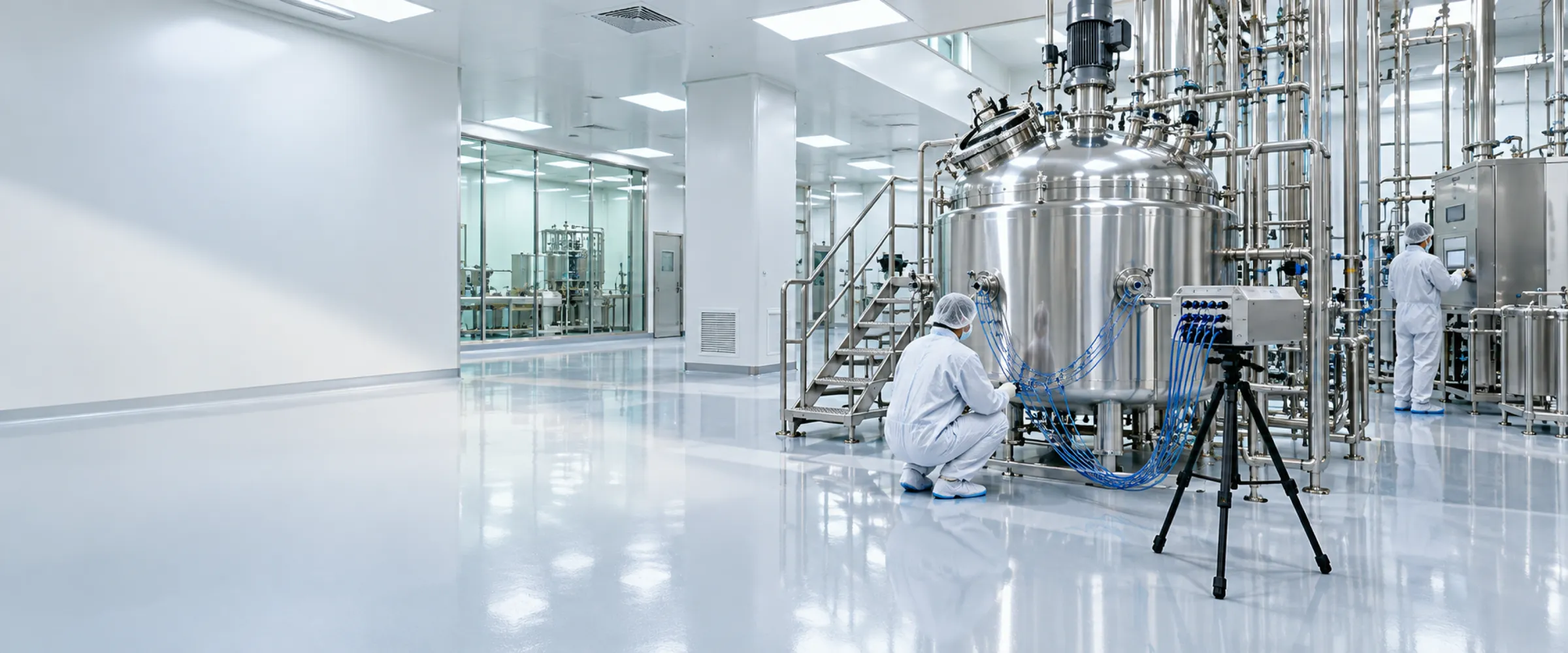
Cleanroom · Classification
Cleanroom Cleanliness Classes
Compare ISO Classes 1–9 and GMP Grades A–D. Specify particle concentration, standard, particle size and occupancy state.
ISO 14644-1ISO Class 1–9 particle limits
| Class | ≥ 0.1 µm | ≥ 0.5 µm | ≥ 5 µm |
|---|---|---|---|
| ISO 1 | 10 | — | — |
| ISO 2 | 100 | — | — |
| ISO 3 | 1,000 | 35 | — |
| ISO 4 | 10,000 | 352 | — |
| ISO 5 | 100,000 | 3,520 | — |
| ISO 6 | 1,000,000 | 35,200 | 293 |
| ISO 7 | — | 352,000 | 2,930 |
| ISO 8 | — | 3,520,000 | 29,300 |
| ISO 9 | — | 35,200,000 | 293,000 |
A dash is not zero; no classification limit is specified for that particle-size/class combination.
Counts are cumulative at and above each size. The 0.2, 0.3 and 1 µm columns are omitted. ISO 9 applies only in the operational state; use the standard's sampling-location, sample-volume and measurement procedures for actual classification.
A lower class number permits fewer particles at a given size. The class alone does not set temperature, humidity, pressure or microbial limits.
Historical ReferenceHistorical FED-STD-209E equivalents
| FED-STD-209E | ISO 14644-1 | Historical unit |
|---|---|---|
| Class 1 | ISO 3 | 1 particle/ft³ |
| Class 10 | ISO 4 | 10 particles/ft³ |
| Class 100 | ISO 5 | 100 particles/ft³ |
| Class 1,000 | ISO 6 | 1,000 particles/ft³ |
| Class 10,000 | ISO 7 | 10,000 particles/ft³ |
| Class 100,000 | ISO 8 | 100,000 particles/ft³ |
FED-STD-209E is withdrawn. These are approximate unit-conversion equivalents, not equivalence of test methods. State the applicable standard, particle sizes and occupancy state in new specifications.
EU GMP Annex 1GMP Grade A–D classification
| Grade | ≥0.5 µm At rest / In operation | ≥5 µm At rest / In operation |
|---|---|---|
| A | 3,520 / 3,520 | Not specified / Not specified |
| B | 3,520 / 352,000 | Not specified / 2,930 |
| C | 352,000 / 3,520,000 | 2,930 / 29,300 |
| D | 3,520,000 / Not predetermined | 29,300 / Not predetermined |
At rest means the installation and HVAC are complete and running, manufacturing equipment is not operating and personnel are absent; in operation includes the maximum personnel performing or simulating routine work (4.29).
Consider 5 µm classification for A/B when indicated by the contamination control strategy or historical trends. Set Grade D operational limits from risk assessment and routine data. Routine monitoring Table 5 separately includes 29 particles/m³ at 5 µm for Grade A; do not substitute it for the classification table.
EnvironmentCleanroom temperature and humidity criteria
The ISO particle-class table does not prescribe one temperature/humidity range for every cleanroom. Derive operating ranges and tolerances from product and process sensitivity, electrostatic and condensation risks, clothing, personnel heat and equipment requirements. EU GMP Annex 1, 9.6 likewise calls for ranges aligned with product, process and personnel needs.
Include set points, allowable ranges, measurement locations/frequency, calibration, records and excursion actions. Verify spatial distribution and performance under changing loads and seasons; relative humidity also changes with temperature.
FiltrationHEPA/ULPA filters and BFU/FFU units
| Type | Meaning | Selection and testing |
|---|---|---|
| HEPA | High-efficiency particle filter, including EN 1822 classes H13/H14 | H13 overall efficiency ≥99.95%; H14 ≥99.995% (MPPS) |
| ULPA | Lower-penetration classes U15/U16/U17 | U15 overall efficiency ≥99.9995% (MPPS); compare resistance/energy with process needs |
| BFU / FFU | BFU is used for Blower Filter Unit; FFU means Fan Filter Unit, combining a fan and filter | Naming varies by manufacturer; specify filter class, airflow, static pressure and installed leakage |
MPPS is the most penetrating particle size. Do not equate EN 1822 efficiencies directly with fixed 0.3 µm ratings. A higher filter class alone cannot guarantee room cleanliness; installed integrity and airflow require verification.
Room FinishesCleanroom flooring and conductive tiles
A cleanroom floor should shed few particles, permit cleaning/disinfection and resist process chemicals and loads. Compare resin coatings, sheets and tiles together with seams, wall junctions and repair methods. Smooth, unbroken finishes matter in sterile manufacturing areas.
Conductive tiles are considered where a process needs electrostatic control. An ISO particle class alone does not mandate them. Define resistance and test methods for the complete system, including footwear, grounding and personnel; a tile certificate does not prove the installed floor's performance.
FAQFrequently asked questions
Frequently asked questions
Which ISO class corresponds to Class 100?
Historical FED-STD-209E Class 100 approximately corresponds to ISO 5 at 0.5 µm. Units and test methods differ; new specifications should state the ISO class, particle sizes and occupancy state.
Does ISO 5 mean GMP Grade A?
Matching a particle concentration limit does not fulfil every Grade A requirement. GMP also addresses process protection, airflow, microbial control, operation and monitoring.
Should every cleanroom operate at 22 °C and 50%RH?
Those are not universal cleanroom limits. Define ranges, tolerances, measurements, records and excursion actions from product, process, personnel and equipment requirements.
Is ULPA always the better choice?
ULPA targets lower penetration, but the required cleanliness, airflow, pressure drop and energy all matter. Check filter class alongside installed leakage and air distribution.
ReferencesSources
- ISO 14644-1:2015, Cleanrooms and associated controlled environments — Part 1: Classification of air cleanliness by particle concentration
- ASHRAE Handbook, 2023 HVAC Applications, Chapter 19: Clean Spaces (ISO table and historical classes)
- European Commission, EU GMP Annex 1: Manufacture of Sterile Medicinal Products (2022), 4.5, 4.27–4.29, 9.6, Table 1 and Table 5
- Camfil, EN 1822:2019 and ISO 29463: HEPA filter factory test
Contact Us
Your next project starts here.
Talk to us about the right engineering approach for your facility, scale and schedule.